
A Legacy of Leadership in Healthcare
Leadership in public health is tested in moments when there is no time to hesitate. An outbreak spreads across borders. A healthcare system strains under pressure. Communities search for answers as uncertainty grows.
These are the moments that shape leaders and Dr. Sylvia Trent-Adams has spent her career answering them. From leading national health responses to guiding global efforts in some of the world’s most vulnerable regions, she understands what it means to make decisions when the stakes are measured in lives. In those moments, steady leadership is not optional. It is essential.
A seasoned healthcare executive and former Deputy Surgeon General and Acting Surgeon General of the United States, Dr. Trent-Adams has built a career defined by service at the highest levels. Her journey has taken her from a rural farm in Virginia to the forefront of national and global health leadership. Over the course of her career, she has served as a nurse, soldier, researcher, Rear Admiral, and university president, with each role reinforcing her belief that healthcare systems must work for everyone.
Now, as President and Chief Executive Officer of the Institute for Healthcare Improvement (IHI), she has stepped into a role that helps shape how healthcare systems evolve across the globe. The organization, widely recognized for advancing quality improvement, patient safety, and health equity, stands at the center of efforts to improve healthcare at scale.
Yet beyond the titles and global impact, what becomes clear in conversation is her authenticity. In her interview with VBD Magazine, Dr. Trent-Adams spoke with quiet confidence and clarity, offering thoughtful reflections on her journey, her values, and the experiences that shaped her path. She was forthcoming and personable, the kind of leader whose work is guided by conviction.
The philosophy that guides her leadership did not begin in policy rooms or research institutions. It began decades earlier, in the quiet countryside of Virginia.
ROOTS IN RURAL VIRGINIA
Dr. Trent-Adams describes herself simply as “a proud Virginia girl.” She grew up in Appomattox County, where life was shaped by farming, family, and a strong sense of community. It was a place where people knew one another, where responsibility was shared, and where the well-being of one often depended on the care of many.
“I grew up on a farm,” Dr. Trent-Adams recalls. “My grandparents, Edwin and Josephine Jackson and Almond and Naomi Trent, had farms in rural Virginia, and it was a very tight-knit community.”
Within that environment, her grandmother became one of her earliest and most enduring influences. Though not formally trained in medicine, she was known throughout the community as someone who showed up when others were in need. When illness struck or hardship arose, she stepped in with quiet compassion and a willingness to help. “I think one of my grandmother’s greatest joys was helping others when they were in a very challenging situation or when there was a need in the community,” Dr. Trent-Adams says.
Those early experiences offered more than a sense of belonging. They revealed both the strength of community and the realities of limited access to care. Healthcare in rural Virginia was not always within reach. “There was only one doctor in the county,” she explains. “If you needed healthcare, you had to drive to Lynchburg or Charlottesville. Sometimes even down to Duke.”
For many families, those distances created real and sometimes difficult barriers. Watching neighbors navigate those challenges left a lasting impression and began to shape her understanding of what equitable care should look like. “Wherever there’s a gap, there’s an inequity,” Dr. Trent-Adams states. “And our responsibility is to close those gaps.”
A FIRST-GENERATION PATH
Education became the bridge that carried Dr. Trent-Adams to national leadership. As the first member of her extended family to attend college, the opportunity represented more than personal achievement. It carried the weight of expectation, responsibility, and the promise of something greater.
She earned a four-year ROTC scholarship to Hampton University, one of the nation’s Historically Black Colleges and Universities, where her path began to take shape.
“I’m the first child of both my grandparents to go to college,” she reveals.
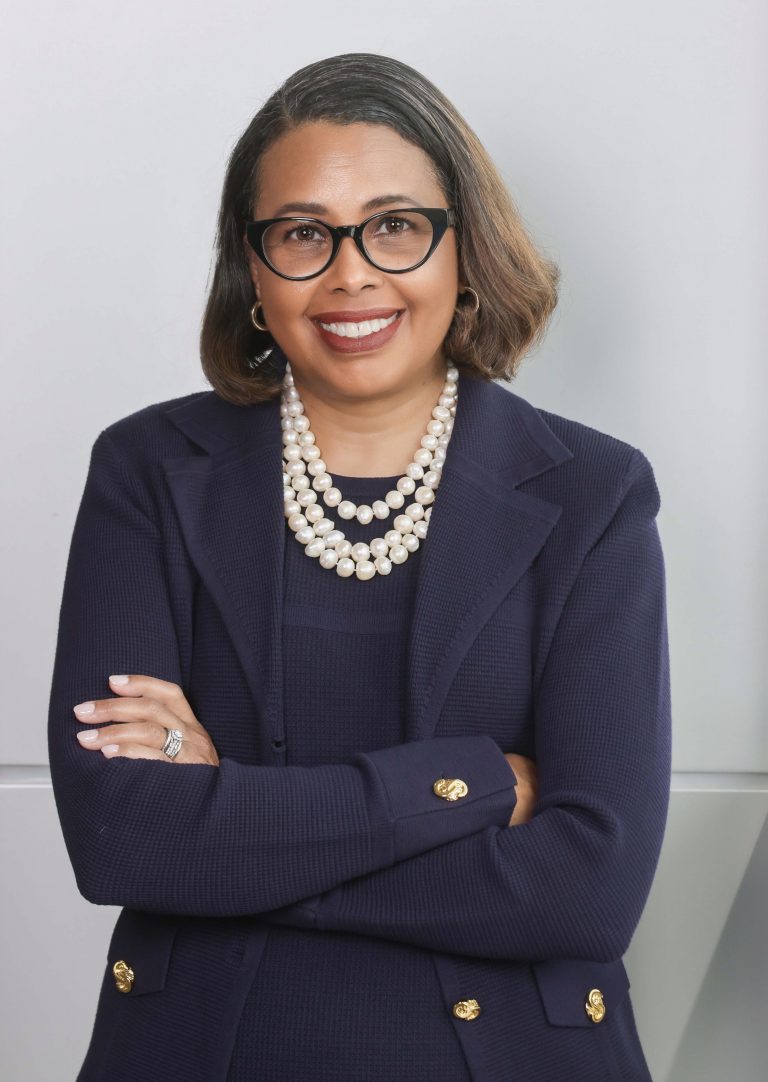
The experience proved transformative. At Hampton, she studied nursing while preparing for service in the Army Nurse Corps, immersed in an environment that emphasized both academic excellence and personal development.
“It was a place where people really cared about the students,” she says. “Not just about your academics, but about making sure you were a well-rounded human being.”
Surrounded by faculty members who believed deeply in the potential of their students, she began to see her future differently. The campus community exposed her to a legacy of leadership and excellence that expanded her vision of what was possible.
“To be on a campus where there were so many brilliant African American leaders was a surreal experience,” she says.
Those years did more than confirm her direction. They sharpened her sense of purpose and defined the role she would carry forward. Nursing would become her pathway to service.
Dr. Trent-Adams received her Bachelor of Science in Nursing from Hampton University, a Master of Science in Nursing and Health Policy from the University of Maryland, Baltimore, and a Doctor of Philosophy in Public Policy from the University of Maryland, Baltimore County.
A CAREER IN PUBLIC SERVICE
A lifelong public servant, Dr. Trent-Adams began her public health career in 1992 when she joined the United States Public Health Service (USPHS) Commissioned Corps. Over three decades of service, she rose through the ranks, ultimately retiring in 2020 as a Rear Admiral Upper Half.
In 2013, she stepped into a key leadership role as Deputy Associate Administrator for the HIV/AIDS Bureau within the Health Resources and Services Administration. There, she helped oversee the $2.3 billion Ryan White HIV/AIDS Program, which provides medical care, treatment, referrals, and support services for uninsured and underserved individuals living with HIV, while also supporting the training of healthcare professionals nationwide.
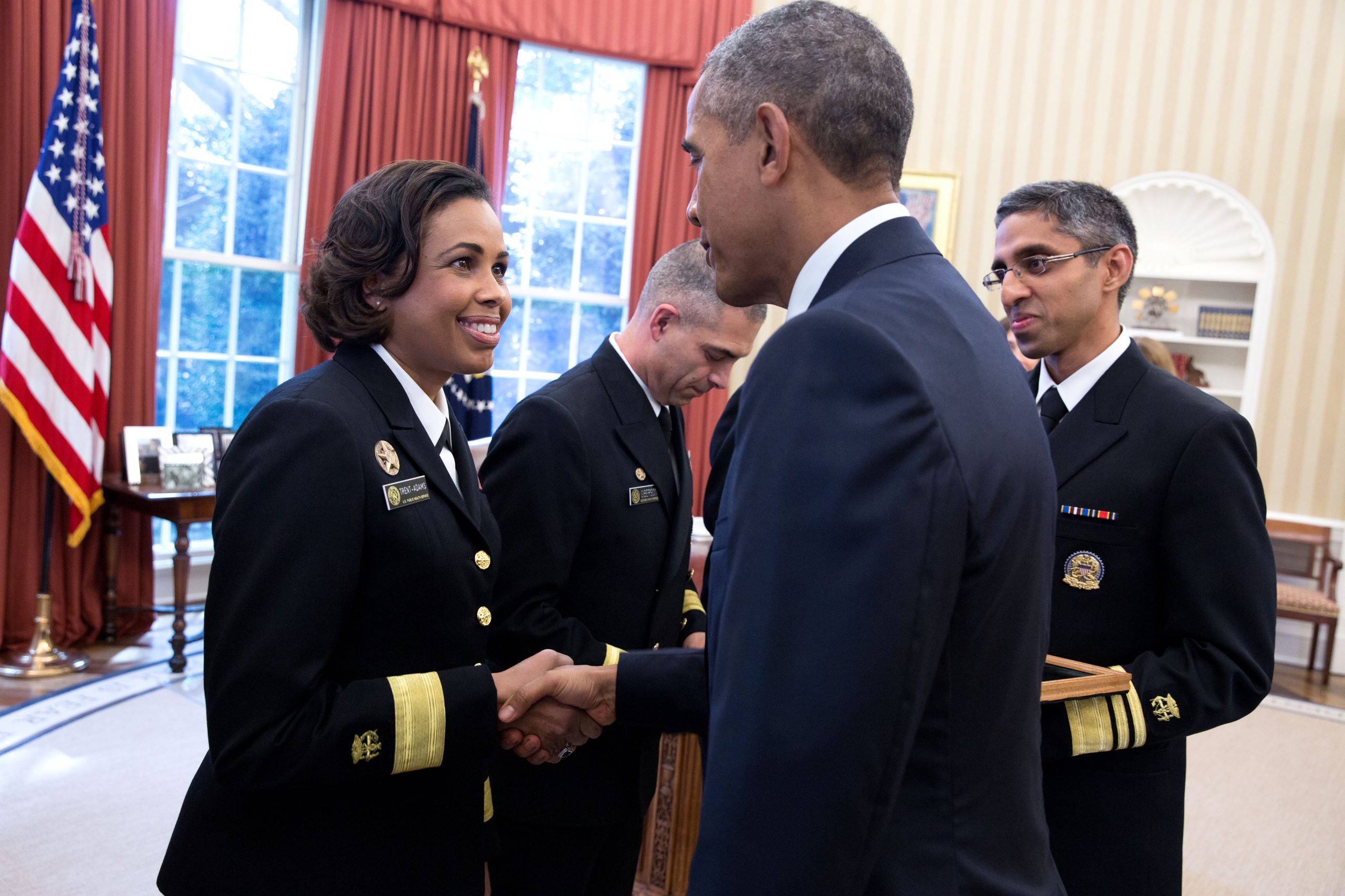
Her leadership continued to expand at the national level when she served as the first African American Chief Nurse of the USPHS in 2013. She went on to serve as Deputy Surgeon General from 2015 to 2018. In that role, she became a trusted advisor on some of the nation’s most pressing health challenges, including efforts to address the opioid crisis. Her leadership during this period reflected both her clinical expertise and her ability to guide complex public health initiatives at the national level.
Dr. Trent-Adams later served as Principal Deputy Assistant Secretary for Health at the U.S. Department of Health and Human Services from 2019 to 2020, leading national and global public health initiatives, directing department-wide policies and programs, and helping manage complex public health response efforts.
Her transition into academic leadership marked another chapter in her career. In 2022, she became the seventh president of the University of North Texas Health Science Center at Fort Worth, where her leadership advanced both research and academic innovation. During her tenure, the institution received a $150 million grant for Alzheimer’s disease research, the largest in the University of North Texas system’s history. She also oversaw the launch of a new College of Nursing, further strengthening the pipeline of future healthcare professionals.
Throughout these roles, she remained focused on communities often overlooked by traditional healthcare systems. “Sometimes people have health insurance,” she explains, “but they don’t know how to navigate the healthcare system.” Without guidance, patients may delay seeking care until medical issues become severe enough to require emergency treatment.
“Equity is about making sure people get what they need in the way that they need it.”
GLOBAL HEALTH ON THE FRONTLINES
Dr. Trent-Adams’ work has frequently placed her at the center of global health crises. One of the most defining moments came during the Ebola outbreak in West Africa. As the first commanding officer on the ground in Monrovia, Liberia, she led the United States Public Health Service response to the epidemic.
The mission required rapid coordination with international agencies, local healthcare workers, and public health organizations. The stakes were enormous as communities struggled to contain a virus that had already claimed thousands of lives. Her leadership during that crisis reflected the qualities that have come to define her career: calm under pressure, strategic focus, and an unwavering commitment to protecting vulnerable populations.
Beyond emergency response efforts, she has represented the United States in global health forums, including the World Health Organization’s Global Nursing Forum. In those settings, she has consistently advocated for stronger public health systems and greater recognition of the vital role nurses play in delivering care.
Dr. Trent-Adams’ contributions to public health have been widely recognized. In 2017, she received the International Red Cross Florence Nightingale Medal, the highest international honor awarded to a nurse. She has also been honored with the Distinguished Service Medal for sustained leadership and dedication at the highest levels of public service, the Meritorious Service Medal for her leadership during the Ebola response in West Africa, and the Surgeon General’s Medallion for her service as Acting Surgeon General in 2017.
Read more here: Subscribe to VBD Magazine’s April 2026 Issue (Free)
Photo Credit: Jill Johnson (2nd photo on the page)